Tensor-ΣΔ Cloud AI Data Training

Aggregated Insights & Complex Reasoning
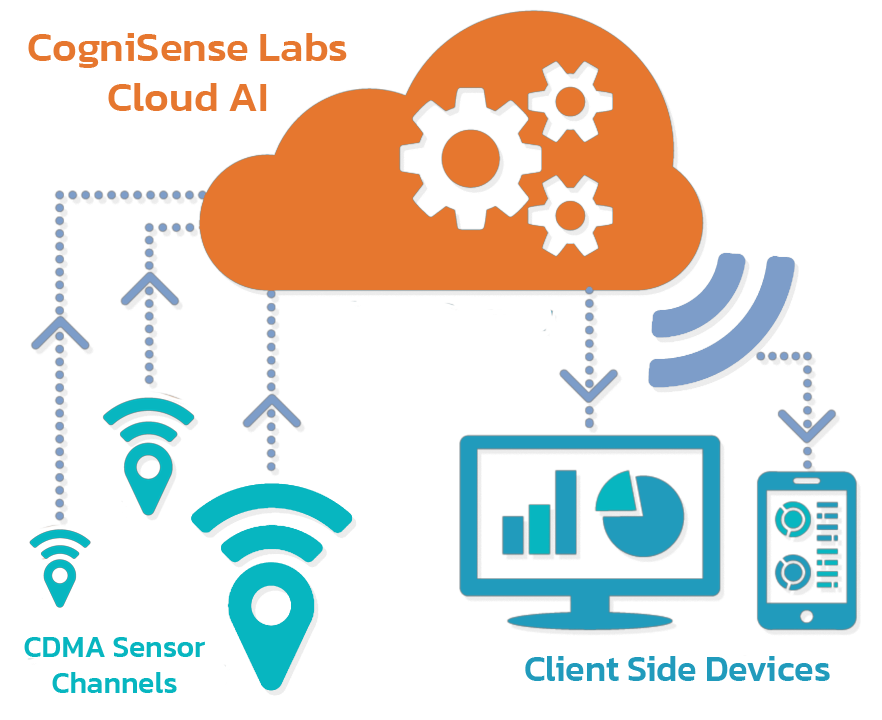
Autonomous

Sensors-t0-Action AI Platform

We plan to build an edge-to-cloud intelligence platform that transforms sensor-rich environments into autonomous, outcome driven operations, delivering measurable efficiency gains and creating a defensible data moat for long-term growth.

The Perception, Reasoning, & Actuation Stack
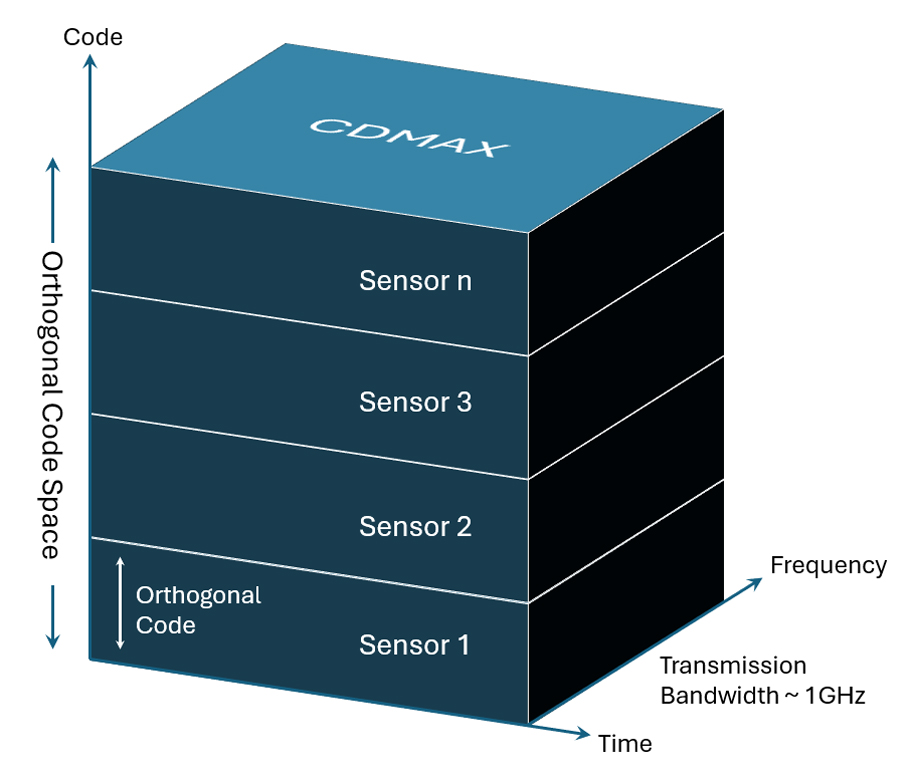
CDMA gives each sensor channel a unique orthogonal code, so the system separates signals mathematically rather than by time slots or frequency slices.

Why CDMA Sensing Is Better For AI Analytics

Orthogonal codes let every sensor stream simultaneously over the same band. The cloud receives a dense, lossless feed instead of a multiplexed or duty‑cycled trickle. That density is what enables high‑fidelity fleet analytics, cross‑site pattern discovery, and model retraining.

Because separation happens in code space, not frequency or time, adding sensors doesn’t expand the RF footprint. The cloud sees linear growth in data volume without nonlinear growth in transport cost or architectural complexity.

Correlation at the physical layer produces high‑SNR, disentangled channels. Cloud models train on cleaner primitives, converge faster, and generalize better across environments. This is the foundation for your domain‑specific models and the defensibility of your data flywheel.

Cloud AI can fuse streams across hundreds or thousands of nodes because CDMA preserves simultaneity. That simultaneity is what enables higher‑order reasoning: anomaly clustering, predictive maintenance, optimization across assets, and cross‑site benchmarking.

Edge agents act on low‑latency local signals, while the cloud uses the full CDMA fabric to refine policies, retrain models, and push improved behaviors back to the edge. CDMA ensures the cloud always has the complete, time‑aligned picture needed to orchestrate the system.